Project overview

Note: If you only want to see the photos, they are after the text (jump to the gallery).

A client asked if we could capture the feel of a “stormy sea” in plaster—movement, depth and a bold texture, not a standard smooth wall.

The project was a brick-lined stairwell that meets the kitchen in central Gothenburg. The surface had to work in everyday use, but also be a consciously designed feature that changes expression depending on light and viewing angle.

This is a strong example of how plastering can be a design material—not just a neutral finish.

Starting point

We started from exposed brick where a new plaster system needed the right adhesion and the right feel. The client wanted a lively texture with depth—but it could not become “too much”, because the wall is seen up close every day.

That’s typical for decorative plaster: the effect must be clear, but also controlled so it feels natural in the space.

The challenge

When you aim for an artistic plaster expression, it’s not enough to “add some texture”. What matters is how light moves across the surface, how depth is built up, and how irregularity is directed so the result feels intentional.

In a stairwell this matters even more, because the wall is viewed from multiple angles and in different lighting (daylight and evening lighting).

Testing and sample rounds

To hit the “stormy sea” feel we ran several sample rounds. Each round let us adjust the mix, aggregate size and how the surface was worked.

Samples matter because plaster reads very differently depending on:

  • light and shadow
  • viewing angle
  • how much aggregate is exposed
  • how the surface is closed/opened during finishing

After a few rounds we reached the right balance: strong movement and life—yet still controlled and practical for everyday use.

Materials and mix

In decorative plaster, material choice is half the result. We eventually landed on a light grey B mortar (BÖ 12) mixed with 6 mm aggregate at roughly 1:6.

That gave a coarse, durable texture with clear grain—and a surface we could shape into directional “waves”.

Note: mixes and ratios are always adapted to the substrate, environment and desired look. In this project, B mortar + 6 mm aggregate provided the right balance.

Execution: from substrate to finish

First we protected the surroundings with masking and plastic so the work could be done cleanly in a space connected to the kitchen.

We then installed reinforcement mesh on the brick and built a stable base layer. Once the base was in place, we shaped the final texture and direction.

The goal wasn’t to literally “paint water” in plaster—it was to capture the same visual energy: a coarse surface with movement that changes as you walk past.

Result

The result is a custom decorative plaster finish with a coarse texture and clear movement. In daylight and softer evening lighting, the wall reads differently—exactly as intended.

The stairwell gained a stronger identity on the way into the kitchen, and the surface feels both hand-crafted and durable in everyday use.

Location

Private home – central Gothenburg; brick-lined stairwell leading into a kitchen.

Want something similar?

Want a plastered surface with more character than a standard finish—for a stairwell, entrance, kitchen or a feature wall? We can help you test your way to the right expression.

Send photos of the space and we can assess the substrate, materials and the best setup. Contact us here.
From exposed brick to a “stormy sea” feel

Step by step: prep work, reinforcement, base coat and the final coarse textured finish that shifts with the light.

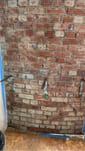
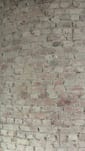
Close-up of exposed brick masonry with older joints, before plaster work.

Starting point: exposed brick where we would build up a new surface with the right feel.

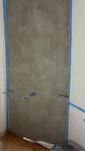
Brick wall masked with blue tape and plastic in a room, preparation for plastering.

Brick stairwell leading into the kitchen—masked and protected ahead of plastering.

Brick wall with fixed reinforcement mesh and fasteners, before plaster application.

Reinforcement mesh installed on the brick—the base the plaster system builds on.

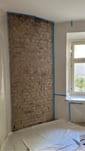
Grey plaster applied on a wall with masking; substrate before the final texture.

First coat: the base layer is applied before the final texture and finish are shaped.

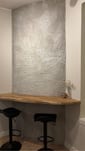
Finished grey textured plaster wall behind a wooden countertop and two bar stools.

Finished result in daylight—a coarse texture with a “stormy sea” feel behind the bar area.

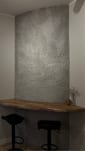
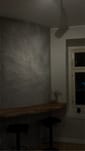
Textured plaster wall with countertop and bar stools in dim lighting.

The same wall in softer lighting—the texture changes with the light.

Wall with coarse grey plaster texture next to a window and countertop in a room.

Overall view: the plastered stairwell wall meeting the kitchen, next to the window.

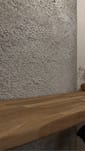
Close-up of coarse grey plaster texture on a wall, with a wooden countertop in the foreground.

Close-up of the texture—a coarse surface with clear movement and grain.

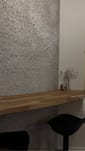
Textured grey plaster wall with wooden countertop, small decor and a bar stool.

Detail by the countertop—a raw, durable surface that works well in a kitchen environment.

Contact us about decorative plaster and custom surfaces

Want something similar, or want to develop a custom plaster texture of your own? Tell us about your project (photos help) and we will guide you forward. We book a free site visit and provide a quote or cost proposal.

Murkvalitet Västsverige AB
Org. no.: 559296-5544
Hakansgardsgatan 85, 434 36 Kungsbacka
By clicking Send, you agree to our terms.

FAQ

Can plaster be shaped into a specific design, not just a standard finish?

Yes. Plaster can be used for far more than a smooth or standard textured wall. With the right mix, materials and handling, it can be shaped into a much more tailored expression.

Why were multiple sample rounds needed?

When expression matters, you rarely go straight to the final surface. Samples are needed to test the mix, texture, aggregate size and how light moves across the wall in real life.

What created the stormy sea feel in this project?

It came from the combination of materials, texture and directional movement in the application. The goal was not to imitate water literally, but to create the same sense of energy and depth.

Which materials did you use?

For this project, we landed on a light grey B mortar (BÖ 12) mixed with 6 mm aggregate at roughly 1:6. That gave the right balance of texture, weight and control.

Does this kind of plaster only work in stairwells?

No. The same type of decorative plaster can work well in entrances, kitchens, halls, feature walls, commercial spaces or anywhere you want more character in the room.

How do you avoid the result becoming too much?

That is exactly what the sample stage is for. We adjust the surface in steps until the structure feels intentional and balanced rather than random or exaggerated.

Can you help create a completely custom texture?

Yes. That is often where we add the most value: when you have a feeling, a reference or an idea, and need help turning it into a workable material finish.

What affects the price?

Price depends on surface area, substrate, the number of sample rounds, material choice and how advanced the texture is. After review, we provide a clear cost proposal.

Can I get a quote for similar work?

Yes. Send a short description and some photos, and we will arrange a free site visit and help you move forward with the right setup.